Documents Required for Security Guard Insurance in the U.S.
The documents you submit for security guard insurance don’t just verify your business. Over and above that, they help insurers precisely measure your level of risk, which can directly influence your premium, coverage limits, policy exclusions, and even whether your application is approved. For example, a company providing armed security at high-risk locations is evaluated differently from one offering unarmed residential patrols.
So, understanding what insurers exactly review before you apply can help you avoid delays, submit a stronger application, and secure coverage that reflects your actual operations. In this guide, we’ll explore which documents are actually required, why each one really matters, along with how they support various policies, including workers' compensation, general liability, and armed security guard insurance. Now, let’s take a deeper dive.
Security guard insurance providers typically require business registration documents, a business license, a security agency license (if applicable), an Employer Identification Number (EIN), payroll records, employee details, claims history, previous insurance information, and details about your security services. Armed security companies may also need firearm permits, armed guard certifications, and training records. Requirements vary by insurer and state.
Security Guard Insurance Checklist

Before applying for security guard insurance, insurers review your business details, services, workforce, and risk history to assess eligibility, coverage needs, and premiums. The documents you will need are dependent on your state of operations and if you are a armed guard or an unarmed guard.
- Business Registration Documents
- Business License Details
- Security Agency License
- EIN or Tax Identification Number
- Payroll Information
- Employee Information
- Security Service Information
- Client Information
- Insurance Claims History
- Previous Insurance Details
- Firearm Documentation (if applicable)
Before gathering your paperwork, use this checklist to understand the documents and information insurers commonly request when you apply for security guard insurance in the U.S.
What is Security Guard Insurance?
Security guard insurance is actually a specialized type of insurance for security companies. It’s a combination of insurance policies that’s designed to protect security businesses from the unique risks they face while protecting people, property, along with assets. This insurance policy helps cover several financial losses that arise from incidents like bodily injury, damage to property, employee injury, legal claims, as well as some specific professional errors. As not every security company operates the same way, insurers customize security company insurance based on the services, workforce, and level of risk.
No matter if you’re an independent contractor or even a growing agency, it’s essential to have the right coverage, and it can help you meet client requirements, manage several unexpected claims, and keep your business running without any major financial setbacks.
Security guard insurance is commonly required for:
- Security guard agencies and private security companies
- Armed and unarmed security guard services
- Mobile patrol and alarm response providers
- Event, residential, and commercial security companies
- Executive protection and bodyguard services
Business Registration and Licensing Documents
Insurance providers in the United States of America review these documents in order to ensure that your security company is legally registered and licensed to operate. While requirements vary state-wise, the following are the commonly demanded documents:
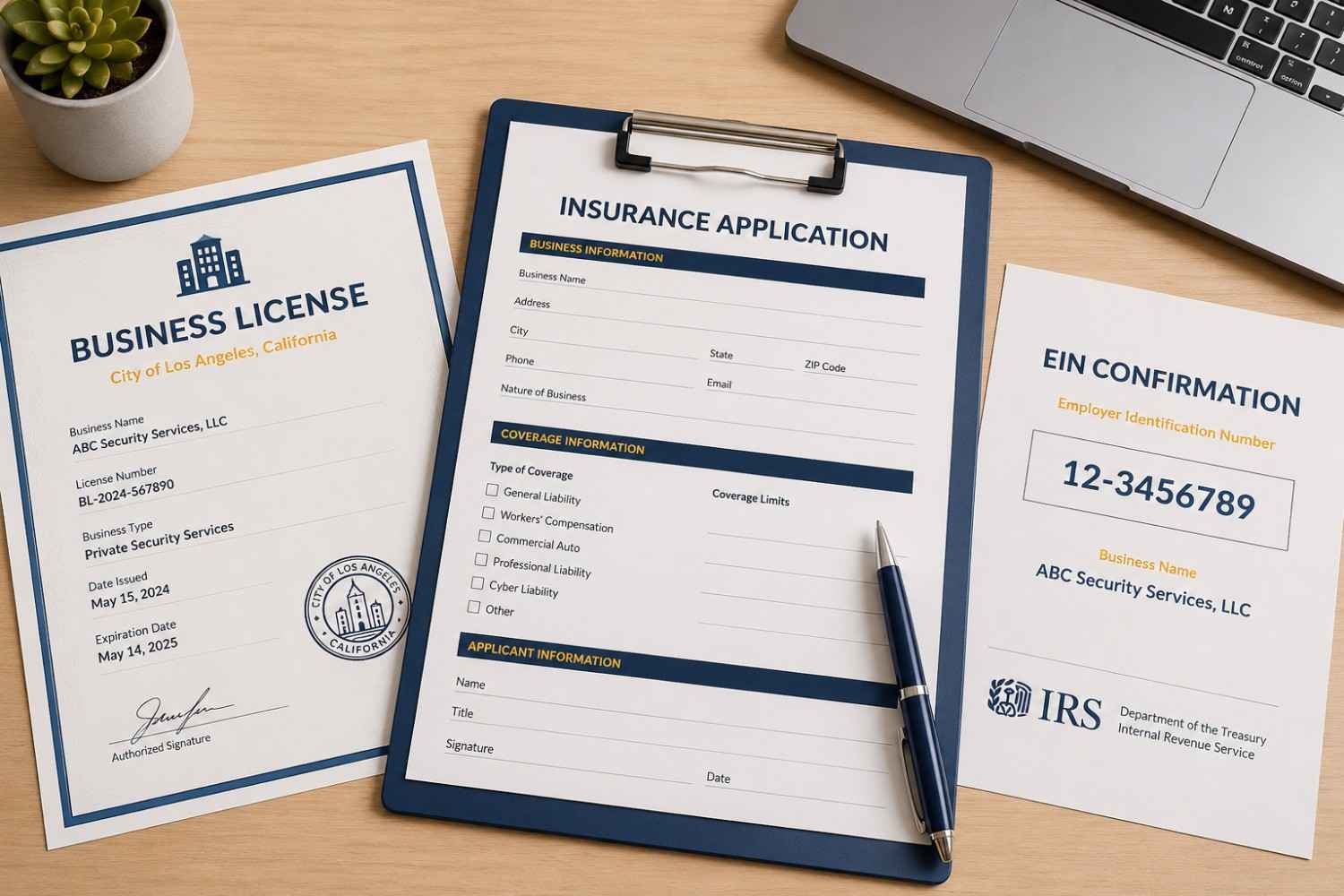
- Business License: First of all, you need your business license. A valid business license confirms that your security company is legally authorized in order to operate within its city, county, or even state. This license helps insurers to verify your business is active, compliant with local regulations, and eligible for coverage as well.
- Security Agency License: The Security Agency License outlines the particular type of security operations your company is approved to conduct under state regulations. Insurance providers review it to comprehend your business activities, apply the correct underwriting criteria, and then recommend suitable coverage.
- Employer Identification Number (EIN): It is issued by the Internal Revenue Service (IRS), and an Employer Identification Number (EIN) serves as your business’s federal tax ID. This is to verify your records of business, prepare policy documents, and accurately processes your insurance application.
- Business Registration Documents: Documents like Articles of Incorporation, Articles of Organization (LLC). Certificate of Formation, or Partnership Agreements, confirm that your business is established legally. Moreover, these records also help the insurer verify your company’s legal structure and ownership before even issuing coverage,
Note: Some insurers may ask for additional licenses, permits, or sometimes specific certification based on the state, the type of security service you provide, and whether your guards are armed or unarmed.
Employee and Payroll Information
Insurers review employee and payroll details just to understand your overall workforce, assess potential risks, and then calculate accurate premiums. This data helps ensure your policy matches your security company’s real operations:
- Number of Security Guards and Employees : You need to provide the total number of employees, including guards, supervisors, as well as support staff. This helps them evaluate the size of your business and overall risk exposure.
- Employee Classifications : Insurers may also ask for employee roles, such as armed guards, unarmed guards, patrol officers, or even supervisors. Now, this classification helps consider the right coverage based on job responsibilities and risk levels.
- Full-Time vs. Part-Time Employees: You also need to share the number of full-time and part-time employees. This is the help insurer understand your overall staff structure and evaluate your coverage needs.
- Estimated or Actual Payroll : Payroll details are utilized to calculate costs for employee-related coverage, like workers’ compensation. New businesses generally provide estimated payroll. On the other hand, established companies submit actual records.
Note: Update your insurer if your workforce size, payroll, or services change significantly during the policy period.
Details About Security Services Offered
Insurers examine the security services to learn what you do, to identify your risks and to customize coverage to help your business run more effectively.
- Armed vs. Unarmed Security Services: Indicate if you are an armed or unarmed security services provider. Generally, armed operations are riskier, as they require compliance with extra requirements, specialized training, and the use of firearms.
- Mobile Patrol Services: Insurers might also request to learn about patrol areas, vehicles, and properties patrolled for mobile patrol security purposes to assess vehicle-related and operational risks.
- Event Security Services: If you are an event security provider, give information on the events you're attending, how many people you are expecting to attend, and what it is you would be responsible for.
- Residential/Commercial Security: Indicate whether you offer residential security services, commercial security services, or both. Different locations, such as homes, offices, retail spaces, and industrial facilities, have different risk profiles.
- Bodyguard or Executive Protection Services: Businesses that offer bodyguard services or executive protection services should include information on these specialized operations, as they come with special risks and coverage needs.
Client and Contract Information
Your insurer reviews your clients, contracts and service locations to get a feel for your business operations and determine the possible risks. This assists them to find out what coverage you need for your security company.
- Clients Include: Explain the kinds of customers you serve (commercial business, residential community, retail store, construction, special event, etc.). There are different levels of risk and liability in various industries and environments.
- Major Security Contracts: Insurers might ask for information regarding large security contracts to be aware of how you are servicing your customers, what those customers need, and what you are possibly obligated to do in the contract. This will help you make sure that your coverage is in line with your work.
- Locations Where Security Services Are Provided: Include the types of properties and areas in which you can provide your security services. Your insurance needs may change based on several locations or high-risk situations.
Claims History and Loss Runs
Insurers check your own claims history and loss-run reports to gauge your own risk history, business profile, and insurance cover requirements. Good claim records allow you to get a more detailed view of your security operations.
- Previous Insurance Claims: Provide information about previous claims, such as the nature of the incident, the date, and the outcome. This assists insurance companies in grasping your claims history and determining future risks.
- Loss-Run Reports: A loss-run report summarizes the insurance claims that have been filed on your policies in the past. It's a way for insurers to assess your losses and base their decisions on those facts.
- Major Past Incidents or Claims: Report on important events, including injuries, property damage, or claims for liability. The level of detail provided during the event and what steps are taken after will affect how an insurer assesses your risk management practices.
Current or Previous Insurance Information
Insurers consider your existing and past insurance coverage to see how long you've been covered, what type of risk you face, and what protection you currently have. This information enables them to suggest appropriate protection for your security company.
- Existing Insurance Policies: Describe in detail what policies are active (e.g., general liability, workers' compensation, commercial auto). This will enable your insurer to see what coverage you have and where it might be lacking.
- Previous Insurer Details: Provide details on past insurance carriers, policy cycles, and coverage. Insurers employ this to assess your insurance record and determine your business risk.
- Previous Workers' Compensation Coverage and Claims History: An understanding of previous coverage limits, renewals, and changes in policies informs an insurer of the appropriate coverage level to provide for your existing business activities.
It is important to have accurate insurance record-keeping that helps facilitate the application process and ensures that your insurance policy is suitable for your security guard business.
Additional Documents for Armed Security Companies
In order to be covered, armed security firms will likely require further paperwork to demonstrate firearm compliance, employee qualifications, and safety protocols.
- Firearm-Related Licenses and Permits: Give valid firearm licenses, permits or authorisations to prove that armed guards are legally approved to carry weapons for security duties.
- Armed Guard Certifications: Provide certification that guards have attended training and are licensed in the state.
- Training and Safety Records: Provide information on firearm training and use of force protocols, as well as firearm safety initiatives, to evidence good risk management practices.
What Types of Insurance Do Security Guard Companies Need?
Security firms are subject to damages, injuries, employee accidents, and liability claims. Good business insurance can safeguard your company from unforeseen financial devastation.
- General Liability Insurance: General liability insurance is used to cover claims from third parties (people other than the insurer) and will cover claims for bodily injury or property damage, as well as allegations of negligence during security operations.
- Workers' Compensation Insurance: Employees' compensation insurance protects employers from related liabilities and helps cover the costs of work-related injuries and illnesses by helping to compensate the employee for lost wages, medical bills, etc.
- Professional Liability / Errors & Omissions Insurance: Professional liability insurance (E&O) covers claims that your security services were inadequate, negligent, or didn't meet contractual requirements.
- Commercial Auto Insurance: Coverage for mobile patrol vehicles and other motor vehicles used in a security operation from the commercial auto insurance program is provided to protect against accidents, damage and liability claims.
- Other Relevant Coverage: If you operate your business, you might also require cyber liability insurance, equipment coverage, umbrella insurance, or firearm liability insurance to cover certain risks.
How to Get Security Guard Insurance?
Having the correct information and documents prepared makes it easy to obtain security guard insurance. Try these tips to ensure you have the coverage that is right for your business:

- Step 1: Gather Your Business Information
- Gather key paperwork such as business registration, security agency license, employees' information, payroll details, claims history, and information about the security services you offer. The faster you're ready the better.
- Step 2: Evaluate Your Coverage Needs
- Determine what types of coverage are required for your business as per the operations of your business. Take into account if you're providing armed vs unarmed security, mobile patrol, event security, company vehicles, and the number of employees you have.
- Step 3: Submit Your Application and Documents
- Fill out the insurance application and furnish the necessary documents in a correct manner. If your application doesn't contain all the correct information, it could cause a delay in underwriting or impact the coverage available.
- Fill out the insurance application and furnish the necessary documents in a correct manner. If your application doesn't contain all the correct information, it could cause a delay in underwriting or impact the coverage available.
- Step 4: Compare Coverage Options
- Don't just Compare Business Insurance Quotes, review insurance company in the U.S. quotes in comparison by comparing coverage limits, exclusions, deductibles, coverage benefits, and insurance premiums. If you select the correct policy, then your security company is getting the proper coverage.
Conclusion
Preparing the required documents in advance can make the insurance process faster, reduce underwriting delays, and help you secure the right level of protection for your security business. From launching a new security firm or refreshing an existing policy,
Alkeme Insurance can compare coverage and pick a policy that fits your operational and compliance needs.