Getting the best insurance for your business is a major step towards protecting the future of your business. Although finding the right insurance in this complicated world of commercial insurance is extremely overwhelming. That’s where the insurance broker comes into the picture. But not all brokers are the same. Selecting the right partner does mean the difference between a nightmare or seamless protection in the time of crisis. This guide will walk you through the exact way on how to choose the right insurance broker for your business.
What Does a Business Insurance Broker Actually Do?
In basic terms, a business insurance broker can act as the advocate and advisor. The right role includes:
- Understanding the business operations plus the exposures.
- Identification of suitable insurance coverage towards the specific needs.
- Approach the multiple insurance carriers based on your behalf.
- Comparing the policy terms, deductibles, exclusions, and the premiums.
- Negotiating the insurers for getting the right possible terms
- Assisting the renewal annually along with the midterm policy changes.
- Providing ongoing risk management guidance.
- Supporting and advocating for you for the claims process.
Insurance Broker vs. Insurance Agent
This is important for knowing the difference for a broker along with the agent before you can start the search:
Note: Market access varies based on brokerage. Avoid any kind of assumption; each broker has access for each of the insurers when in the market.
Start by Understanding Your Business Insurance Needs
Before you begin the interviews of brokers, your businesses should have a major understanding of major exposures. Take the right time for evaluation:
- Your industry and type of operations.
- Number of the employees plus the payroll size.
- Business locations along with inventory, property, and equipment.
- Company vehicles and driving records
- Professional services that are offered as third-party/customer risks.
- Cyber issues and data exposure.
- Contractual or regulatory insurance requirements (for instance, client mandates)
- Claims history
- Planned new locations, expansions, or new services.
Not sure what to cover? See the types of insurance every growing business needs.
Key Factors to Consider When Selecting an Insurance Broker
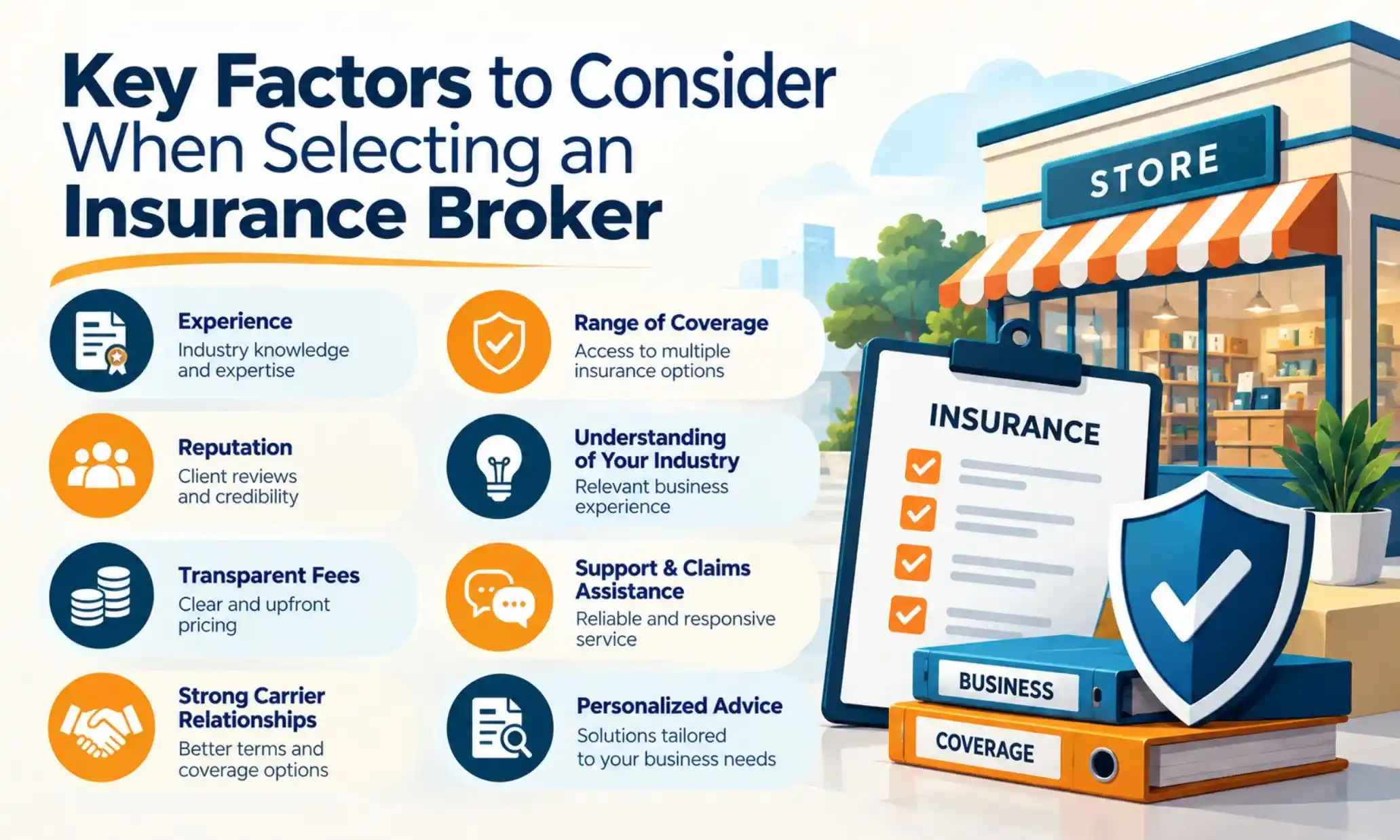
Choosing the broker for the long-term partnership. Evaluate based on these ten critical factors:
1. Look for Relevant Industry Experience
Don’t just check how many of the years of brokerage that have been operating. Ask some of the questions like
- Have the insured business for a specified industry?
- Do they understand the common claims under the sector?
- Are they ready or familiar with industry -focussed regulations.
- Can they identify the right kind of exposure that’s unique to the operations?
- Can they regulate work with companies of similar size?
For an example of industry-specific coverage, read our retail store insurance guide.
2. Evaluate the Broker's Access to Insurance Markets
A broker’s relationships with the insurance companies that will influence these are the number of options that are available, premium competitiveness, coverage flexibility, and the right ability to ensure that specialized risk. Question you should be asking:
- What carriers generally are good at your work?
- Which insurance operators can you easily work with?
- How many markets can you approach through that quote?
- Do you have access to a specific number of insurers that’s required?
Note: Getting access to a higher number of insurers does not mean you will get a better broker. The relevance of a carrier matters much more than just some longer list of names.
3. Check How Thoroughly They Assess Your Risks
This can differentiate a "quote-focused" broker from the right kind of “true” advisory broker. A great broker will get you to ask some questions like the business operations, locations, payroll, revenue, operations, contracts, equipment, previous claims, subcontractors, cyber exposures, and business continuity before you offer a price.
4. Compare Coverage, Not Just Premiums
Businesses generally compare Broker “B” price to Broker "A." Although premiums do not reveal whatever kind of policies provide equal protection. You need to compare coverage limits, exclusions, endorsements, sublimits, business interruption coverage, policy conditions, and property valuation methods along with liability protection.
5. Understand Their Claims Support
The claim time is that broker relationship; that’s the most important. Just ask:
- Who can contact immediately even after a loss?
- Will help us towards submitting and managing the claims?
- Will the team communicate it directly with the insurer?
- Do you advocate for the clients if the claim is disputed?
- Do you have the internal claims to the teams?
- What response time can you expect?
- Can you provide an example of how to assist a client for that complicated claim?
Note: Brokers will not guarantee that claim approval, as insurers can determine it based on certain policy terms. The broker’s value directly lies in communication and guidance, along with advocacy.
6. Review Their Risk Management Services
A valuable commercial insurance broker will provide much more than just policy placement. Look for the brokers who can provide the risk management, workplace safety guidance, loss-control reviews, cybersecurity risk guidance, claim analysis, employee safety training, contract insurance reviews, and property-loss prevention along with the business continuity service.
7. Evaluate Communication and Responsiveness
Great service directly means clear explanations without the excessive jargon, a defined point of contact, proactive renewal reminders, timely responses, and the updates as and when the market evolves. Most importantly, ask: Who can manage the account after we become the client? The person that sells the account after we can become the client? The person that sells the account cannot be the person that handles the day-to-day servicing.
8. Ask About the Renewal Process
Understand the major difference for an automatic renewal (or a simple requote) for the annual risk assessment. Businesses do change every year: the revenue grows, new employees join, new equipment is purchased, new offices open, contracts become bigger, and services change, plus there is an increase in cyber exposure. Your broker needs to reassess the risks annually, not about auto-renew.
9. Review the Broker's Reputation and Track Record
Evaluate the years in industry specialization, business, testimonials, client retention rates, professional credentials, and case studies, as well as licensing. Instead of relying only on general online ratings, request references from the companies for the comparable risks.
10. Understand How the Broker Is Compensated
Brokers that receive commissions from the insurers, service/brokerage fees, combinations, and consulting fees that depend on the jurisdiction and arrangement. Businesses need to ask for that complete transparency around the compensation and additional service charges. Note: Broker compensation structures and disclosure rules that can change by location.
Questions to Ask Before Hiring an Insurance Broker
Keep a basic checklist ready at the time of interviews:
- How much experience do they have with that industry?
- What types of risks do businesses like us generally face?
- What type of insurance carriers do you have access to?
- How can you assess the current insurance program?
- How can you determine appropriate coverage limits?
- How can you explain certain exclusions as well as policy differences?
- How will the account be managed every day?
- How quickly can you respond to the client’s requests?
- What role do you play if we need a claim?
- What risk management services can you provide?
- How can you handle annual renewals?
- Can you provide the references from the similar businesses?
Red Flags to Watch for When Choosing an Insurance Broker
Be attentive if a broker:
- Just quotes a price without even understanding your business or business needs?
- Focusing only on getting to the lowest tier of premiums
- Not able to explain clearly regarding exclusions in policy.
- Shows limited knowledge of the specific industry.
- Is unclear of the compensation or broker fees.
- Has almost nil defined claims process.
- Experiences frequent changes for account managers
- Recommending identical coverage each year without the reassessment.
- Not able to explain why a certain policy or carrier is getting recommended.
Should You Choose the Cheapest Insurance Broker?
Not generally. Although price should be a major aspect of decision-making, businesses need to understand the total value provided: Market access + coverage quality + service + expertise + claim advocacy + price +risk management. A basic, cheaper proposal can be a better option only when the coverage is genuinely comparable. Do confirm the savings that are not created for hidden higher deductibles, additional exclusions, and lower limits.
When Should a Business Consider Changing Insurance Brokers?
Consider making a certain change that you notice:
- Your broker contacts you rarely outside the time of renewal.
- Communication is either unclear or slow.
- Coverage is not reassessed even though there’s a lot of business growth.
- They generally lack market expertise or lack market options.
- You get improper/poor claims support.
- These are the unexplained premiums that increase or those persistent coverage gaps.
- Your business has expanded to the new services, countries, or states, and your broker is not updated.
Final Checklist for Selecting a Business Insurance Broker
- Understand the risks along with unique risks.
- Has access to reputable and suitable insurance carriers.
- Conducts the customized, detailed risk assessment.
- Clearly explain the policies, exclusions, and limits.
- Communicates compensation and fees directly.
- Can support the company as it scales and grows.
Conclusion
A great business broker needs to help protect your business and not just sell a policy. Take the right time to compare expertise, coverage quality, market access, claims support, and longer-term services before you choose the broker. A broker that can understand how exactly the business operates for those is in a better position for recommending the best solutions that can evolve for the company's changing needs.
Frequently Asked Questions
1. What should I look for in a business insurance broker?
You need to look for deeper industry knowledge, coverage expertise, broad insurer access, proactive risk management services, and responsive and clear communication.
2. How do I compare business insurance brokers?
Don't compare the premiums. Compare the deductibles, coverage limits, exclusions, and financial strength of the carriers that they can represent and the level of ongoing risk management along with the claims support process that they provide.
3. Is an insurance broker better than an insurance agent for a business?
For most of the businesses, actually yes. Brokers work based on the clients and work in multiple markets for finding the customized coverage. Agents that represent specific insurance companies and that have limited options.
4. Does an insurance broker help with claims?
Yes, the insurance company will make the final decision for a claim. A great broker that can guide you through the process, help in submitting documentation, communicate with the adjuster, and advocate for the dispute queries.
5. How often should a business review its insurance broker and coverage?
You need to review the coverage for the broker at least on an annual basis, or even the business experiences for a major change, like adding in new locations, purchasing expensive equipment, hiring more employees, or launching the new services.