Why are Pharmaceutical Company Policies Important?
Strong internal policies help organizations maintain regulatory compliance, product quality, improve patient safety, and reduce operational risks. They also build trust with customers and regulators. Weaker policies, on the other hand, lead to multiple risks: product recalls, manufacturing shutdowns, regulatory penalties, license suspension, FDA warning letters, and major reputational damage. This guide outlines the essential policies every pharma business needs.
Which Pharmaceutical Companies Need These Policies?
These are some of the important policies for pharmaceutical companies that are important for:
- Pharmaceutical manufacturers
- Biotechnology Companies
- Active Pharmaceutical Ingredient (API) companies.
- CRO (Contact Research Organizations)
- CRO (Contract Manufacturing Organizations)
- Vaccine manufacturers and machine devices.
- Nutraceutical firms that operate under pharmaceutical regulations.
Top 10 Essential Insurance Policies for a Pharmaceutical Company
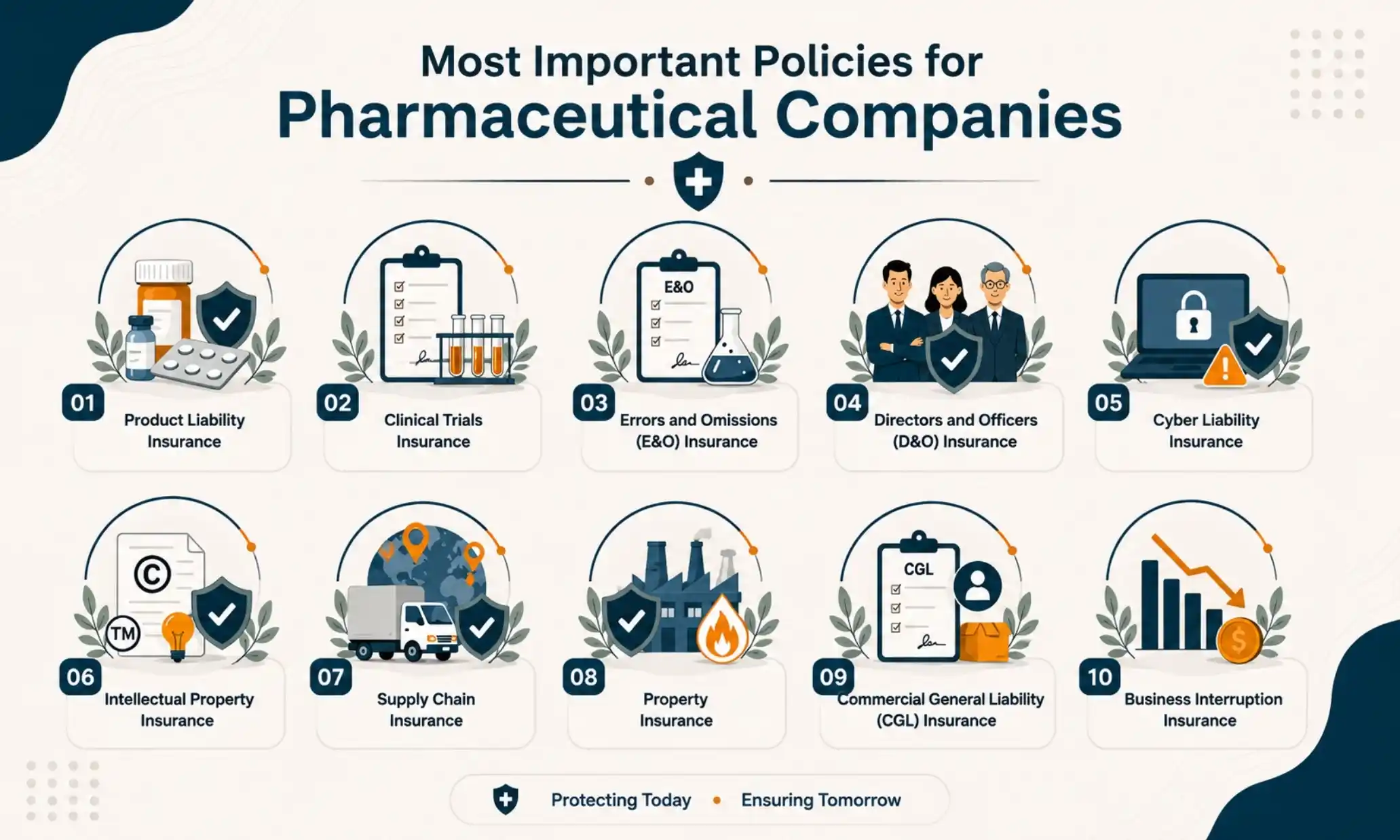
Ensuring comprehensive insurance coverage is essential for pharmaceutical companies to manage the various risks inherent in the industry. Here are ten of the most important insurance policies:
1. Product Liability Insurance
Provides coverage for claims arising from injuries or damages caused by pharmaceutical products, including medications, vaccines, and other pharmaceuticals. This coverage extends to legal defense costs, settlements, and judgments in lawsuits alleging defects, side effects, or failures of the products.
2. Clinical Trials Insurance
Covers the risks associated with conducting clinical trials to test the safety and efficacy of new drugs or treatments, including liability for injuries to trial participants along with legal defense costs and other related expenses.
3. Errors and Omissions (E&O) Insurance
Also known as professional liability insurance, this provides coverage for claims alleging negligence, errors, or omissions in professional services such as research and development, regulatory compliance, and pharmacovigilance.
4. Directors and Officers (D&O) Insurance
Protects directors and officers from personal liability for alleged wrongful acts or decisions made in their roles, covering legal defense costs, settlements, and judgments in lawsuits alleging breach of fiduciary duty or mismanagement.
5. Cyber Liability Insurance
Protects against financial losses and liabilities resulting from data breaches, cyberattacks, and other cyber security incidents, including data breach response, forensic investigations, notifications, and regulatory fines.
6. Intellectual Property Insurance
Covers legal expenses and damages arising from claims of infringement or misappropriation of intellectual property rights, including patents, trademarks, copyrights, and trade secrets.
7. Supply Chain Insurance
Covers losses resulting from disruptions or failures of suppliers, distributors, or other third parties, including business interruption, extra expense, and contingent business interruption coverage.
8. Property Insurance
Protects against physical losses or damage to facilities, equipment, and inventory caused by perils such as fire, theft, vandalism, and natural disasters, helping ensure business continuity.
9. Commercial General Liability (CGL) Insurance
CGL insurance provides coverage for bodily injury, property damage, and personal injury claims arising from the operations of pharmaceutical companies, including premises liability, product liability, and advertising liability. As a core form of general liability insurance, this coverage helps protect against third-party lawsuits alleging negligence or other wrongdoing.
10. Business Interruption Insurance
Provides coverage for lost income and extra expenses incurred when a company is unable to operate due to covered perils such as fire, natural disasters, or other insured events.
These are some of the most important insurance policies for a pharmaceutical company to consider, but the specific insurance needs of each company may vary depending on factors such as their size, operations, geographic location, and risk profile, smaller manufacturers and startups exploring commercial insurance for small businesses may need a more tailored approach compared to large-scale operations.
At a Glance: Top 10 Pharmaceutical Company Policies
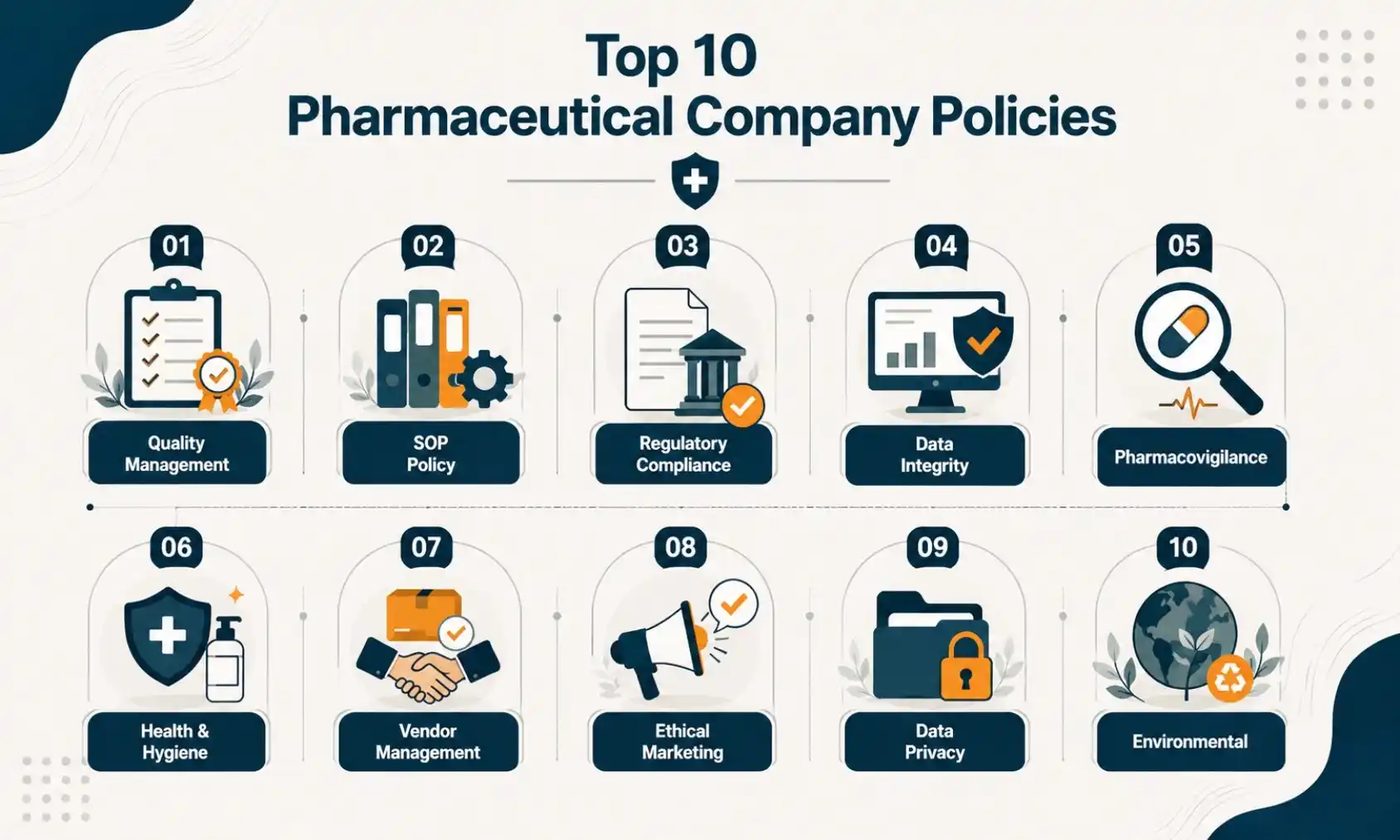
Detailed Pharmaceutical Company Policies
1. Quality Management Policy (QMS)
- Why This Matters: This is an important backbone for patient safety and compliance.
- What it covers: Batch consistency, quality assurance, and Corrective and Preventive Actions (CAPA).
- Batch Practices: Conducting regular management reviews and use of eQMS (electronic QMS).
- Consequence of Weak QMS: Failed inspections, patient harms, and product defects.
2. Standard Operating Procedures (SOP) Policy
- Why This Matters: Ensuring that every task is performed correctly and consistently.
- What It Covers: Approval workflows, SOP creation, version control, employee training & periodic reviews.
- Best Practices: Keeping SOP accessibility, updating these SOPs after process modifications or changes, and mandating annual training.
- Consequences of Poor SOP Management: Deviations and operational errors along with regulatory citations.
3. Regulatory Compliance Policy
- Why it matters: Keeping the company authorized through legal means and selling products.
- What it covers: EMA, FDA, WHO-GMP, CDSCO licensing and regulations, inspection readiness, and product registration.
- Best practices: Assigning a highly dedicated offer for tracking updates on a global level and ensuring compliance.
- Consequences of Non-compliance: Import bans, fines, or worse, facility shutdowns.
4. Data Integrity & Documentation Policy
- Why it matters: Regulators should trust your data that’s unadulterated and accurate.
- What it covers: Principles of Attributable, Legible, Contemporaneous, Original, Accurate (ALOCA+), electronic signatures/records, audit trails, backups, and retention.
- Best Practices: Sanctioned automatic audit trails and banning of shared passwords.
- Consequences under poor documentation: Rejected applications, warning letters, and credibility loss.
5. Pharmacovigilance Policy
- Why it matters: Protection of patients for monitoring of drug safety as per market release.
- What it covers: Signal detection, adverse event reporting, risk management, safety monitoring & stringent reporting timelines.
- Best Practices: Training of complete staff towards recognition and reporting of adverse events.
- Consequences of Weak Pharmacovigilance: Lawsuits, undetected safety risks, and market withdrawal.
6. Employee Health, Safety & Hygiene Policy
- Why it Matters: Preventing product contamination and protecting the worker's well-being.
- What it covers: Hygiene standards, PPE usage, cleanroom behavior, and routine medical examinations for preparedness under emergencies.
- Best Practices: Enforcing the strict growing procedures for conducting the hygiene audits.
- Consequences of Poor Hygiene: Batch rejections and microbial contaminations.
7. Supply Chain and Vendor Management Policy
- Why It Matters: The product that has the raw materials.
- Why it covers: Supplier audits, vendor qualification, material traceability, performance monitoring, and cold chain management.
- Best Practices: Auditing of critical suppliers and maintaining secondary suppliers for the key materials.
- Consequences of the weak vendor management: Contamination of raw materials or supply shortages.
8. Anti-Bribery & Ethical Marketing Policy
- Why it matters: Maintaining integrity and prevention of illegal promotional practices.
- What that covers: PhRMA and UCPMP code adherence, gift policies, anti-bribery standards, conflict of interest, and promotional materials approvals.
- Best Practices: Requiring the compliance sign-offs for all those marketing materials before release.
- Consequences of those ethical violations: Criminal changes and massive fines
9. Data Privacy & Confidentiality Policy
- Why it matters: Protection of clinical, corporate, and sensitive patient data.
- What it covers: DPDP, HIPAA, role-based access, clinical trial confidentiality, data encryption, and cybersecurity.
- Best Practices: Conducting the regular privacy training and cybersecurity penetration.
- Consequences of Data Breaches: Heavy fines, legal action, and loss of public trust.
10. Environmental & Waste Disposal Policy
- Why it matters: Ensuring better handling of hazardous byproducts.
- What it covers: Hazardous waste, pharmaceutical waste disposal, wastewater treatment, and expired medicines for the sustainability initiatives.
- Best Practices: Partnering with the certified environmental waste disposal.
- Consequences of Environmental Non-compliance: The EPA violates plus extreme environmental damage.
Benefits of Strong Pharmaceutical Company Policies
Effective policies help organizations improve patient safety and product quality, achieve audit readiness, increase operational efficiency, strengthen brand reputation, support international expansion, and improve employee accountability.
How to Implement Pharmaceutical Company Policies Successfully
- Performing that compliance gap assessment.
- Easy-to-read and development of clear written policies.
- Training employees with the document attendance.
- Conducting the routine plus supplier audits.
- Utilizing the eQMS (electronic quality management systems)
- Scheduling the privacy policy to encourage continuous improvement.
Common Mistakes in Pharmaceutical Policy Management
Frequent issues include outdated SOPs, inadequate employee training, poor document control, weak CAPA processes, ignoring data integrity, poor vendor qualification, inconsistent implementation, and lack of policy reviews across departments.
Why Insurance for Pharmaceutical Companies Matters
Strong policies reduce regulatory and operational risks, but they cannot prevent unforeseen incidents. This is where pharmaceutical insurance becomes critical, without adequate coverage, a company risks becoming underinsured company, leaving it to absorb massive financial losses on its own when a major claim or incident hits.
- Product Liability Insurance: Covering legal costs for producing the harm.
- Product recall insurance: Covering the massive costs for pulling a defective batch towards the market.
- Clinical trial insurance: Protection of liabilities for drug testing.
- Cyber Liability Insurance: Covering those data breaches plus the ransomware attacks.
- Environmental Liability Insurance: Covering the cleanup costs for these hazardous waste spills.
- D&O insurance & professional indemnity: Protecting the consultants and leadership towards the negligence claims.
Finding the best insurance for pharmaceutical companies means partnering for the reliable pharma insurance company that can understand the insurance. Do remember, the insurance complements compliance and risk management; this does not replace the robust internal policies.
Risks of Weak Pharmaceutical Policies: A Case Study
Imagine a pharmaceutical manufacturer that can neglect that, skips the employee training and SOP updates, and fails to audit that new material vendor. Under a routine inspection, investigators can check out for big documentation gaps or supplier failures for qualification criteria.
Potential outcomes:
Potential outcomes include a product recall, immediate production shutdown, an FDA warning letter, customer trust erosion, heavy financial penalties, delayed product launches, and significant documentation gaps.
The lesson: proactive policy management is far cheaper than reacting to compliance failures.
Frequently Asked Questions (FAQs)
What are pharmaceutical company policies?
These are formal written rules and procedures that ensure a company operates ethically and safely, and follows compliance with global standards.
Why is pharmaceutical compliance important?
It ensures that medicines are safe and effective, protects patient health, and keeps the company legally able to operate.
Which policies are required for GMP compliance?
SOPs, quality management, employee health & hygiene policies, and data integrity are fundamental to GMP (Good Manufacturing Practice) compliance.
What is a Quality Management System (QMS)?
A QMS is a formalized system that documents procedures and processes for meeting responsibilities, objectives, and policies.
What are ALCOA+ principles?
A data integrity framework ensuring data is Attributable, Legible, Contemporaneous, Original, Accurate, and also complete, consistent, enduring, and available.
How often should SOPs be reviewed?
SOPs should be reviewed at least annually, and immediately whenever a process, regulation, or equipment changes.
What happens if a pharmaceutical company fails a regulatory inspection?
The company can receive a warning letter, be forced to halt production, face fines, or have its manufacturing license suspended.
Why is insurance important for pharmaceutical companies?
Insurance provides financial protection against unpredictable risks such as product recalls, cyberattacks, lawsuits, and environmental incidents.
Conclusion
The strong pharmaceutical company policies that are not those regulatory checkboxes are the foundations towards potential safety, business survival, and operational excellence. By implementation of these 10 essentials along with backing up with the pharmaceutical industry insurance, companies will navigate these regulatory landscapes and deliver the safe and life-saving medicines for the world.