You just had a new contract, and the client wanted to be named as the additional that’s insured on your policy. Another week later, and your equipment lender notifies you to be the loss payee under that same policy. Two requests from those unfamiliar terms. If you mix up these requests, someone will go and send that paperwork back to you.
This type of confusion is understandable. Both for the additional insured and the loss payee, which involve adding in a party name for the insurer. But the two can protect in different ways, and knowing the difference can save time, endless mail for your agent, and the possibility of a delayed loan or stalled contract.
The short way: an additional insured shares the responsibility for the liability protection, while the loss of payee has the financial claims for the insured property. Let’s break it down to what that means in practice.
What is an Additional Insured?
An additional insured for a business or person that’s added to the liability policy, generally the commercial auto or general liability, so they can get protection if they get sued because of operations or work.
Why would a client want this? Picture someone’s crew that damaged the third-party property of the job site. The injured party will not only sue you. They will generally name the general contractor and property owner as well, because these parties are involved as well. By requiring that additional insured status for your policy, the general contractor makes sure that your insurance works for your claims and not based on theirs.
Key points for the additional insured status
- This applies to liability coverage: injury claims, lawsuits, or property damage claims that are done during operations.
- The additional insured that’s covered under the liability that arises based on work, not for some independent negligence.
- This has been added through an endorsement; that’s a written amendment for your policy, and not to mention for the certificate of insurance.
- Common endorsement forms that include ISO CG20 10 for those ongoing operations along with CG 20 37 for those operations that are complete. Most construction contracts require both.
- Adding in one or two additional insureds that rarely change the premium, though long lists can make that higher in a slight way.
Who typically asks to be an additional insured?
- Those general contractors that require it to be contractors.
- The landlords or property owners that require vendors and tenants.
- Municipalities that issue permits for construction or events
- Companies that hire security firms, on-site service providers, or cleaning crews.
If you run a trucking, contracting, or security business, you nearly expect serious contracts for including additional equipment insured. This is a basic practice, and refusal of it means losing the job.
What is a Loss Payee?
A loss payee is a business or a person that has the financial interest in property that have you insured, usually for the lessor, lender, and financing property. When the property is destroyed or damaged, the insurance company can pay the loss payee first, or this is jointly with you, up to the amount for that interest.
The basic classic example is you can finance a $160,000 truck. Until that loan is paid, your lender has a major stake in that vehicle. If that truck gets totaled, the lender then needs the insurance payouts applied towards the loan balance rather than just deposited towards the general bank account. Listing them for the loss payee for your physical damage, thus making the coverage guarantee exactly in that scenario:
- This applies towards the commercial property insurance coverage: physical damage to commercial vehicles, buildings, equipment, and inventory as well.
- The loss payee does receive the claim payments alongside or before you for their financial interest.
- This provides the lender zero/no liability protection. This is about who will get the check.
- For a solid version, called the lender loss payee endorsement, protecting the lender of the payment rights if the claim is denied, for instance, because of the misrepresentation of that part.
Who typically asks to be a loss payee?
- Finance and banks companies that hold loans on equipment or vehicles.
- Equipment lease companies
- Mortgage holders or commercial companies
- Suppliers that secure the interest in inventory.
Additional Insured vs. Loss Payee: Side-by-Side Comparison
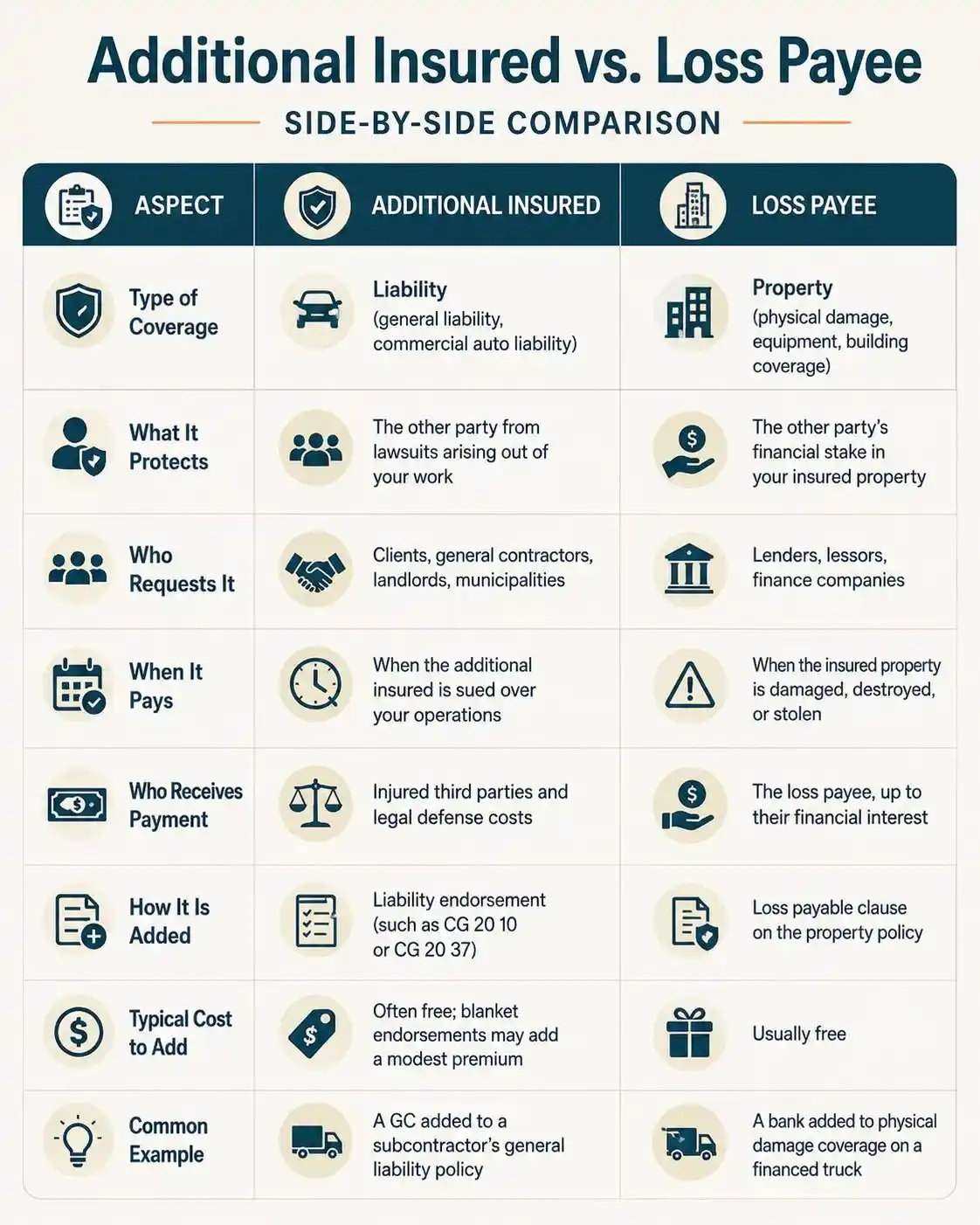
The Core Difference in One Sentence
As the additional insured can borrow your protection. A major loss payee will claim your payout.
One can shield another business from the lawsuits that’s connected to your work. The other makes sure that the lender can get paid that gets financed or wrecked. That is why the same trucking company will carry in both for the commercial auto policy: the shiper or broker that’s listed for the additional insured towards the liability side that’s listed as loss payee for the physical side damage.
Real-World Scenarios: Which One Do You Need?
Scenario 1: Subcontractor under construction project: The basic contractor’s agreement requires it to name it as an additional insured for that general liability, that includes completed operations. Your agent can add that endorsement, issues the updated certificate for insurance, plus be cleared on start.
Scenario 2: Finance a new box truck: The lender when closing the checklist does require proof towards physical damage coverage for their name plus address list. That’s a loss payee request. No change towards the liability coverage when needed.
Scenario 3: Leasing of a commercial kitchen space: The landlord does require actually both. They want that additional insured status towards your liability policy for case towards customer slips and furthermore sues on building owner, and for further if they finance the equipment when they are using, they want the loss payee status towards the property coverage.
Scenario 4: Security Company that signs for a new client: The client wants the protection if it can guard actions that can lead to lawsuits that can name them too. That directly means additional insured towards the general liability policy. It’s the standard for the security contracts, so confirm the new policy before you can sign it.
Common Mistakes to Avoid
Listing the lender as additional insured: This is a very general mix-up. This gives the lender basic liability protection that’s not needed and skips the payment rights, which is exactly what they want. Most of the lenders can reject the basic certificate and delay your fundings.
Assuming the certificate for insurance is enough: a basic certificate that is the major proof of coverage. The additionally insured coverage status requires the actual coverage for the policy for the experienced risk managers that can check.
Forgetting completed operations coverage: Most construction contracts do require additional insured protection towards claims that can surface after that job is done. If the endorsement covers only for ongoing operations, you can opt out of compliance for knowing it.
Not renewing who is still listed for renewal: sold equipment, old clients, cleaning up the endorsements, paying off loans, and cleaning up your endorsements for each year so every year is not extending towards coverage or payment rights for parties that do not need them.
Signing the contract before checking in the policy: Some of the liability policies that limit the additional insured obligations. Send in the contract inquiries for the agent before the agent you sign, not after.
How to Add an Additional Insured or Loss Payee
This process is simple for what the businesses can expect:
- Send in the requests for the agent or broker, ideally with the exact wording from that lender or contract checklist.
- Your agent can identify the endorsements or clause and confirm the policy support.
- The insurer can issue the endorsements for an updated certificate of insurance.
- You deliver the certificate towards the requesting party.
Most of the insurers process for a day or two. If you can sign contracts in a frequent manner, ask about the blanket additional insured endorsement. This automatically covers the party that you can contractually require for adding and eliminating the per-request paperwork.
Frequently Asked Questions
Can the same company be both an additional insured and a loss payee?
Yes, the equipment lessor, for instance, might be a loss payee for the equipment coverage for protecting the asset and the additional that’s insured for the liability policy for protecting against the lawsuits that involve the equipment use.
Does adding an additional insured raise my premium?
Adding in one or two can cost almost nothing or a little. Long lists or blanket endorsements of the additional insured thus increase premiums in a modest way that can expand on who the policy defends.
Does a loss payee have any say in my claims?
A loss payee that has no control over the liability claims. For the property claims that involve those covered assets, the insurer thus includes them for the payment, which can generally be needed for loan payoff or sign-off before that can proceed.
What is the difference between a loss payee and a lender's loss payee?
A basic loss payee’s rights thus depend upon the claim that’s valid. Before the lender’s loss payee gets paid for a claim that’s denied because of something that you did, that’s why the banks increasingly insist on the lender’s version.
Is a mortgagee the same as a loss payee?
These are the close cousins. A mortgage clause for the real equivalent, which is used for lenders or commercial buildings, typically carries stronger protections that are similar to that of the lender’s loss payee.
Get the Right Names on the Right Coverage
Contract requirements should not slow your business down. Whether a general contractor needs additional insured status by Friday or your lender is holding up truck financing over a loss payee listing, the fix is usually a same-week endorsement, as long as your policy is set up correctly in the first place.
ALKEME's commercial insurance specialists handle additional insured and loss payee requests every day for trucking fleets, contractors, restaurants, and security firms. We will review your contracts, confirm your policies support the endorsements you are being asked for, and get certificates issued fast, so you can sign the contract, close the loan, and get back to work.