California is a major private security market across the United States, with around 240,000 security personnel/guards working through the BSIS (Bureau of Security and Investigative Services). This is one of the toughest and strictest places to work and operate at. Insurance is not going to be a great decision here. It’s a legal condition of holding your license.
If you run a security company in California, you’re applying for a PPO (Private Patrol Operator) license; this guide is designed to help you understand and cover every aspect of that. This will help you to understand what a full insurance program looks like beyond some legalities and what you're required to pay.
What California Law Requires: The $1 Million PPO Minimum
Each license PPO, or Public Private Operator for California, should carry commercial liability insurance through minimum limits of $1,000,000 for any one loss or occurrence, which includes property damage, bodily damage, or even death. This type of requirement comes through the California Business and Professions Code Sections 7583.40 and 7583.39; further, the BSIS enforces the three points:
- For the initial leisure, before the initial PPO license can be issued
- For every renewal.
- Constant during the license time.
That was not the rule always. For years, some PPOs that employ those armed guards need to carry the insurance. Occurrence-based coverage is important yet mandatory, and the Bureau should be named as the certificate holder so that it can learn for the cancellation before your client does.
Note: Just mark the policy renewal date for at least 45 days before the BSIS license renewal. For the insurer that non-renews and that you need for remarketing the policy, a perfect replacement certificate that can take two or three weeks for it to be issued, and the BSIS will not just process for the renewal without the one.
BSIS Certificate of Insurance Requirements
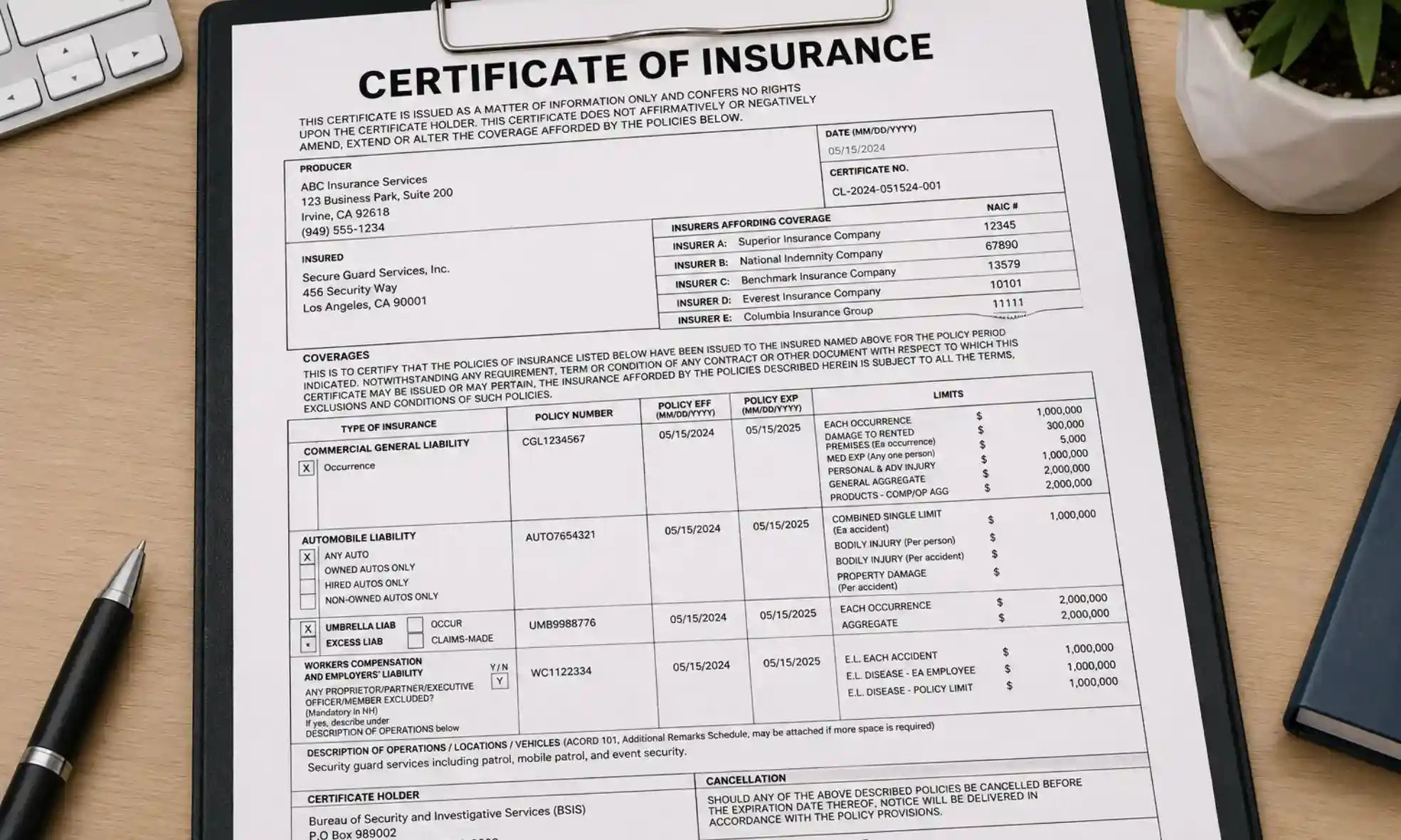
Getting the policy is just half of the compliance job. BSIS will only accept a certificate for liability insurance that does meet the following:
- Shows the PPO company name exactly as it appears on your BSIS license
- Lists your PPO license number
- Lists the policy number with policy start and end dates
- Reflects at least $1,000,000 in general liability coverage per occurrence
- Names the Bureau of Security and Investigative Services, P.O. Box 989002, West Sacramento, CA 95798 as the certificate holder, so BSIS is notified if your policy status changes
- Shows the policy is written on an occurrence basis, not claims-made
Certificates that miss any of these details get rejected, and a rejected certificate can hold up a license application or renewal for weeks. An agent who works with California security companies regularly will format this correctly the first time. Our checklist of required documents for security guard insurance walks through the full paperwork stack.
The Coverage a California Security Company Actually Needs
The state keeps the minimum you are licensed. It also keeps you protected. A basic guard-related injury claim under the commercial property can go around $1 million fast, and the state of California juries are known for their long verdicts.
Two of these deserved the special attention in this state:
Assault and battery coverage: Most standard basic liability coverage policies sharply limit or exclude claims that involve altercations. For any security company, the job involves altercations. An insurance policy without the battery coverage and affirmative assault leaves the hole exactly where the risk is at the maximum. Always confirm that the right coverage is included and then click on submit.
From ALKEME's security practice team: The first thing we can check for any type of policy for a security company that can bring in the assault-plus-battery language. A basic $1 million liability directly means that certain altercation claims are just outright excluded or capped at $25,000. This is a major gap that has been discovered here and a majorly expensive one for discovering after the claim.
Workers' compensation: California requires that for each employer, the classifications of security guard should carry meaningful rates as of the injury exposure. The accuracy under payroll reporting is also a factor here. Misclassified payrolls are just an audit surprise for California security firms.
Armed vs. Unarmed: How It Changes Your Insurance
The BSIS licenses for ten thousand guards for the firearm permits in California, towards the armed work changes for the insurance picture in a significant manner:
- Liability premiums typically run 40 to 60 percent higher for armed operations
- Insurers require proof of BSIS firearm permits and documented training
- Firearms liability must be specifically included; discharge claims are excluded from many base policies
- Underwriters review use-of-force policies, training logs, and supervision practices
Even if armed work is a small slice of your revenue, disclose it. An undisclosed armed post can void coverage on the exact claim you need paid. For a deeper look at how policies treat these operations differently, see our breakdown of armed vs. unarmed guard coverage and common exclusions.
Important: Basic disclosure can work for both directions. If you drop the armed services for mid-term, tell the insurer for that too. Removal of the exposure that can reduce the premium for the audit, plus carrying the risk profile that can make future renewals quicker.
What Does Security Guard Insurance Cost in California?
The pricing directly depends upon guard count, payroll, unarmed vs. armed mix, claim history, and more. Event work or nightclub costs much more than the gated community. These ranges reflect what small- to mid-size security companies can typically see:
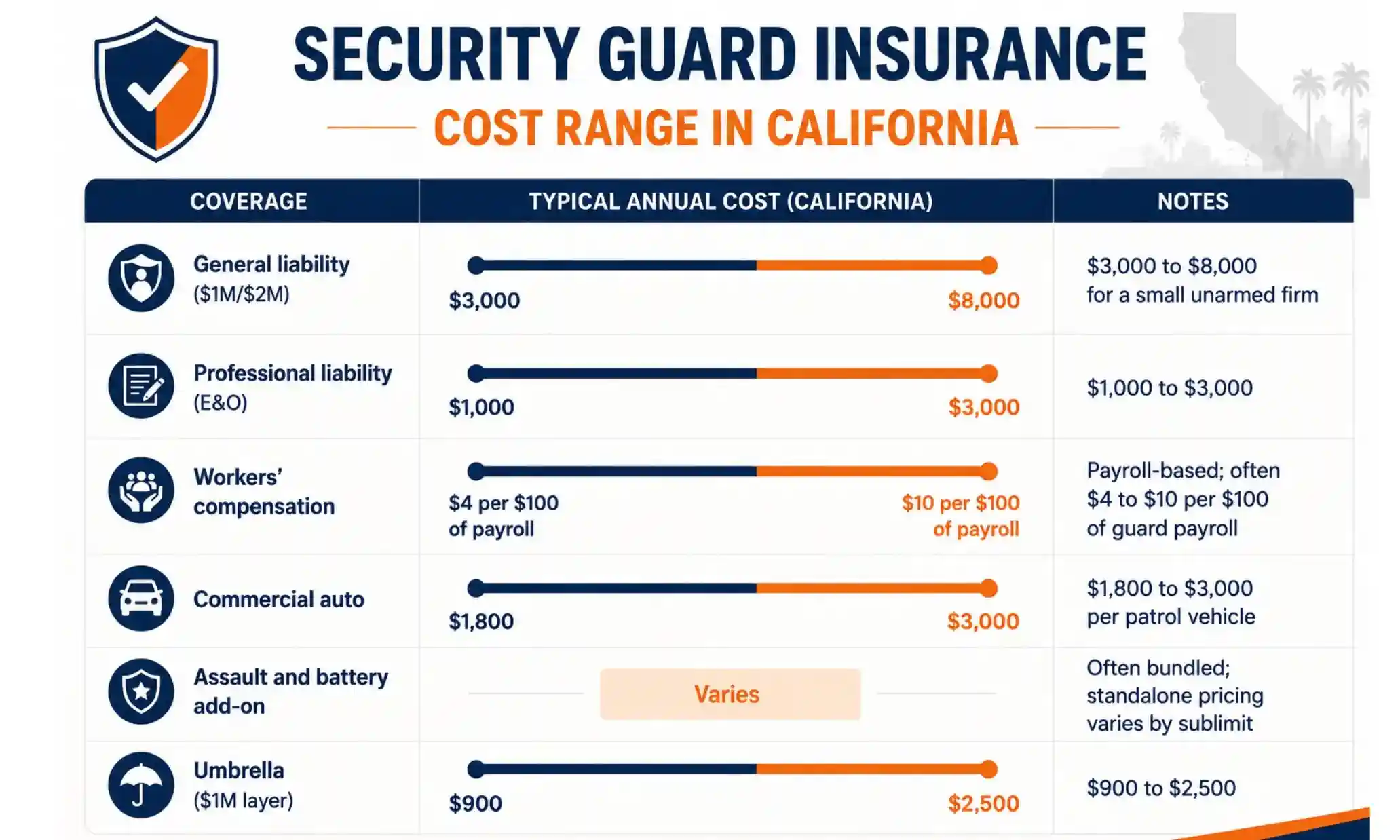
As the rough benchmarks, the major five-guard unarmed operations thus land on between $5,000 & $12,000 every year when all-in, while the firm that runs the patrol vehicles and armed posts, along with the 15 to 25 guards that can expect the $25,000 to $60,000 or even more, drivers generally work through comp payroll as well as armed payroll. The basic factors that can move the price the quickest are claim history, arming, and the risk profile:
Certain ways through which California firms can keep the costs down:
- Document Training: Insurers that can credit towards documented de-escalation, site-specific training, and use-of-force programs.
- Classification of Payroll Correctly: Separating supervisory, office, and field payroll can prevent those overcharging audits.
- Bundle Coverage: A basic single coverage that combines E&O, GL, and the auto industry can beat the stitching together for standalone policies.
Note: Just keep a basic single payroll that can log towards log split for role (supervisor, field guard, office) from the start. For your worker’s comp audit, the right spreadsheet can save California security firms thousands of dollars for the reclassified premiums.
Why California Contracts Demand More Than the State Minimum
The BSIS minimum of $1 million will get you licensed, but this cannot ensure that you get hired. The commercial property managers, municipalities, and event venues, plus the California, do require:
- $2 million for the general aggregate.
- Additional status for insurance naming the client.
- Waivers for subrogation for workers’s comp.
- $2 million umbrella limit and $5 million for bigger accounts
Winning better contracts in California is often an insurance problem before it is a sales problem. Firms structured to issue compliant certificates fast, with the endorsements clients demand, consistently beat cheaper competitors to signed agreements. Our guide to security company insurance covers how the full program fits together.
Frequently Asked Questions
Is Insurance required for a California security guard license?
The perfect insurance needs sit based on the company level. Each licensed private control operator should maintain around $1 million for general liability coverage based on the condition of licensure. The individual guards that carry in BSIS registration (guard card) for those covered for the employer’s policies.
Do unarmed security companies in California need insurance?
Yes, California law has been extended across the insurance requirements for all the PPOs, and not just for those that employ armed guards.
What happens if my policy lapses?
The BSIS can be listed for the certificate holder for the policy specifically that is notified through cancellations. A basic lapse can put the PPO license at risk and the operations without the valid license for the misdemeanor.
How much is security guard insurance in California for a small company?
Most of the unarmed firms land based on $5,000 & $12,000 each year for the corporate program, for the workers’ compensation for the largest variable. Armed operations plus event-heavy work are pushing the cost higher.
Does general liability cover a guard involved in a physical altercation?
Does that policy only include battery coverage or assault? Most of the base policies that exclude that are single for the most important exclusion for the California security for it to check.
Can I use my personal auto policy for patrol vehicles?
No, the personal auto policies do exclude the business use, plus patrol operations for the clear business use. The company vehicles do need commercial auto insurance.